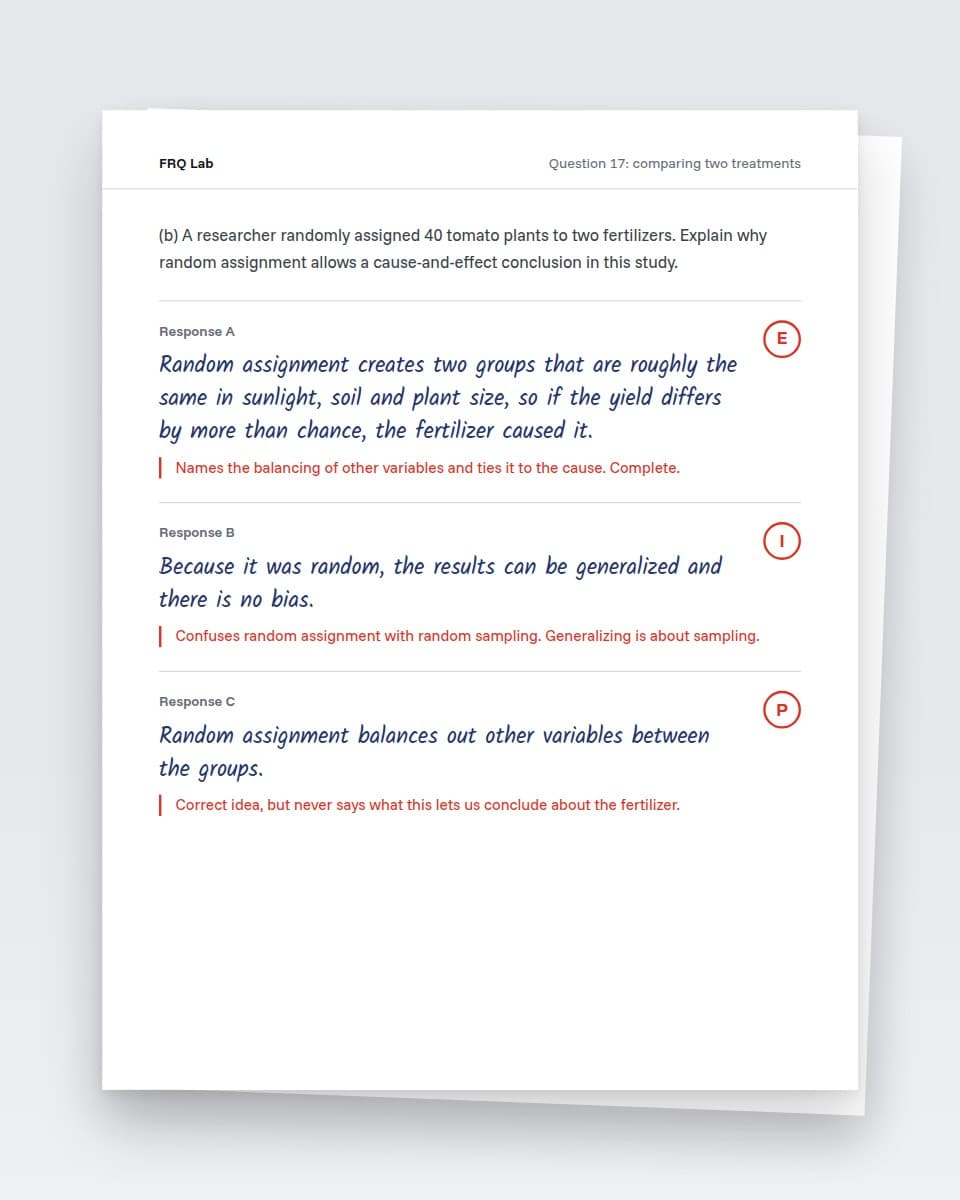
Every question is written from scratch
No recycled exam questions. Claire writes each prompt, then writes the complete answer before she writes any of the weak ones.
In June 2016, Claire Donnelly spent seven days scoring free-response answers for the AP® Statistics exam. By the second day she could predict the score of an answer from its last sentence.
The students who lost points were rarely the ones who couldn't do the math. They were the ones nobody had shown how a reader reads. Sigmalane is her attempt to show every student, before May.
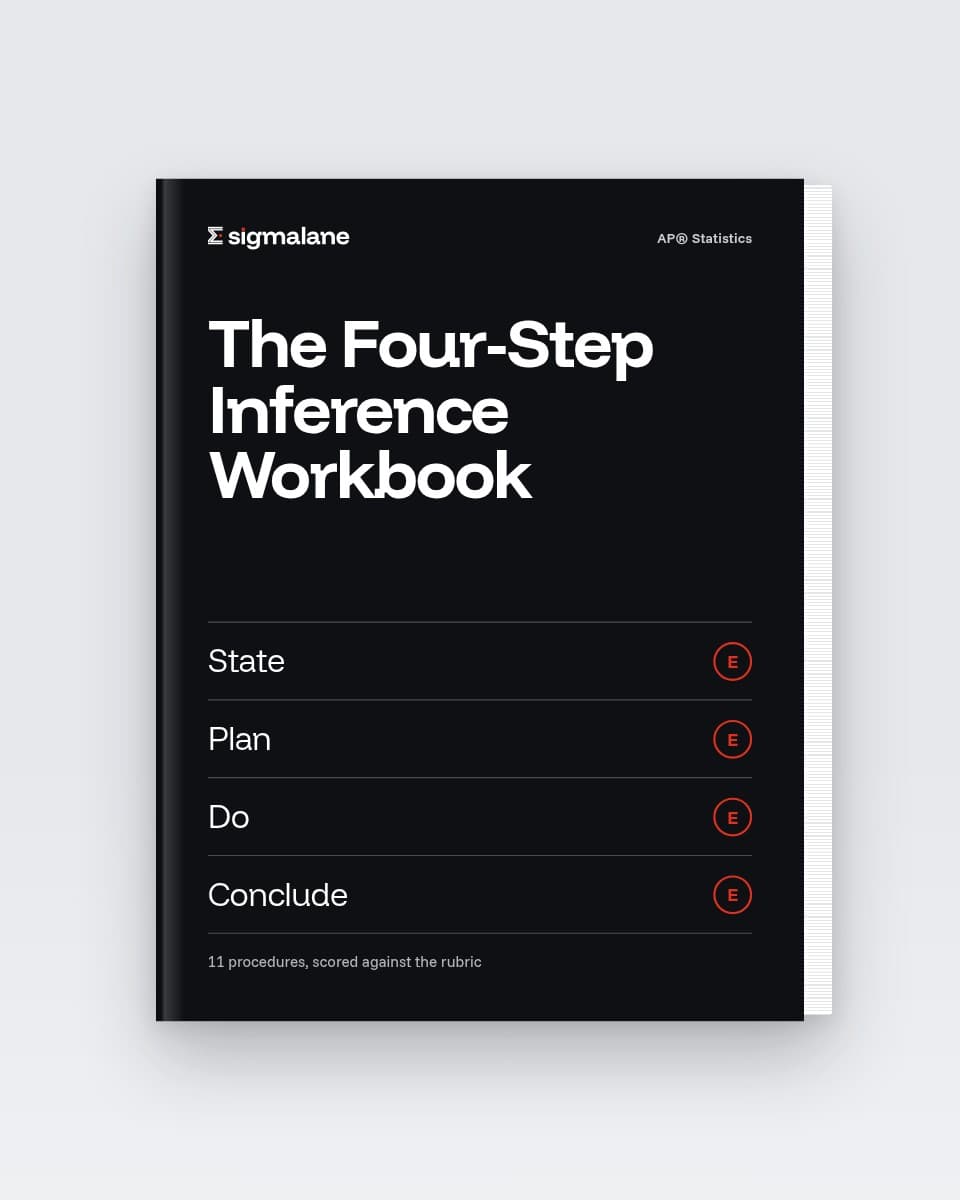
The first book, in 2021. It has been revised five times since.

Sigma is the sum. On the exam, your score is the sum of small points: a parameter defined, a condition checked, a conclusion in context. The lane is the route to them, the same four steps every time, so that nothing is left to luck on the day.
Claire still writes every page herself, from Lyon, and still answers the emails. Questions about a book come to her directly.
Seventeen years of teaching, scoring and writing, in seven dates.
2009
First AP Statistics class
Claire starts teaching AP Statistics at a public high school in Columbus, Ohio, with 23 students and one borrowed set of graphing calculators.
2016
First June as a reader
She spends a week scoring free-response answers. Most lost points are not math errors. They are missing context, unchecked conditions, and “proves”.
2017
The four-step handouts
Back in class, she rewrites every inference lesson as State, Plan, Do, Conclude, with the rubric printed next to it. Her students call them the sigma sheets.
2019
A move to Lyon
Her family moves to France. She keeps scoring online every June and keeps getting emails from former students asking for the sheets.
2021
Sigmalane opens
The sigma sheets become The Four-Step Inference Workbook, a 168-page PDF. It is still the book most students buy first.
2023
Practice, then rehearsal
FRQ Lab and The May Rehearsal follow, built from the questions students asked by email about the Workbook.
2026
The whole course, in ten titles
Ten ebooks cover the whole course, from describing a dotplot to a t test for slope. Each one is revised every summer.
Three rules for every Sigmalane book, from the two-page card to the 296-page mock exams.
No recycled exam questions. Claire writes each prompt, then writes the complete answer before she writes any of the weak ones.
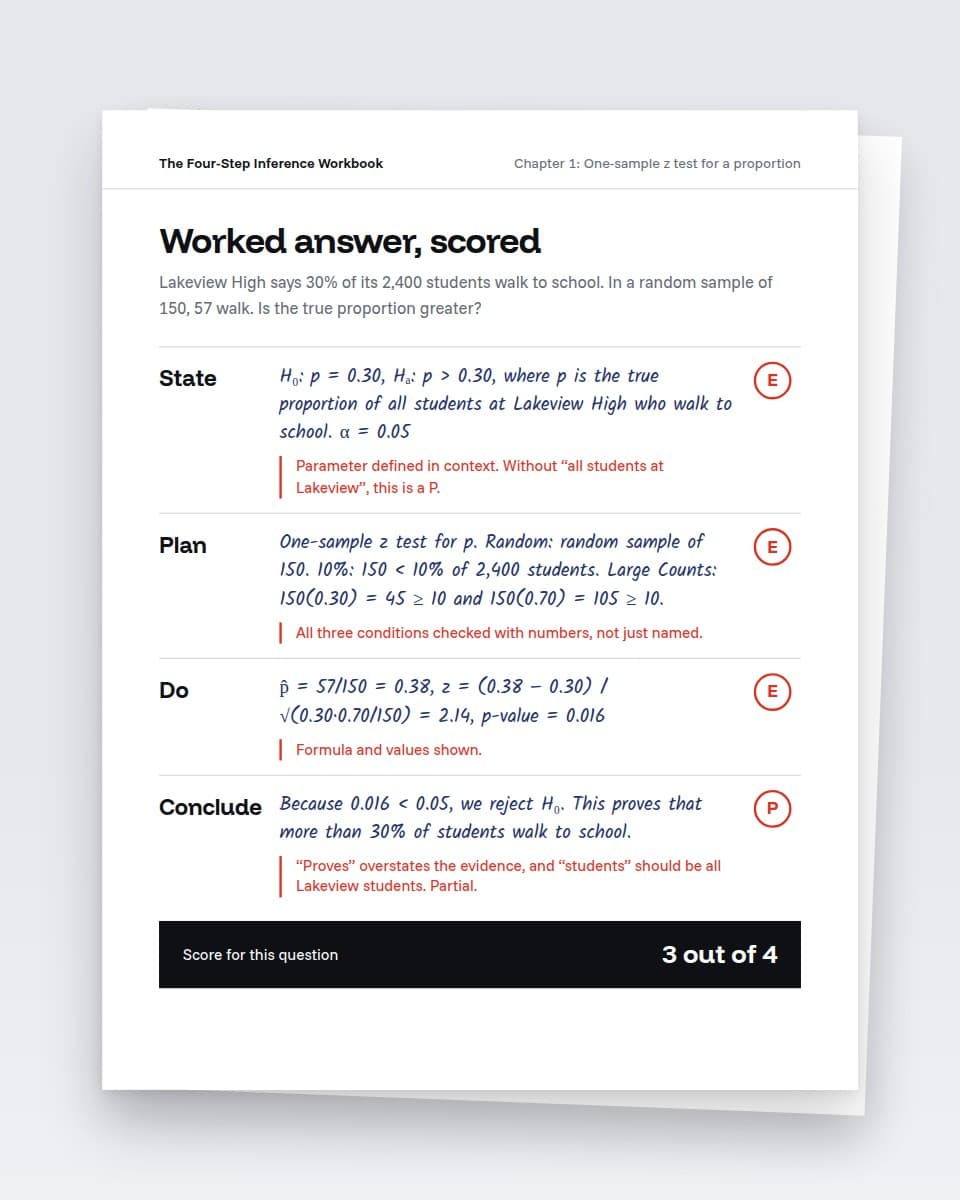
Each part gets E, P or I, with a note naming the exact words that earned or lost the point. If a note can't name them, the answer gets rewritten.
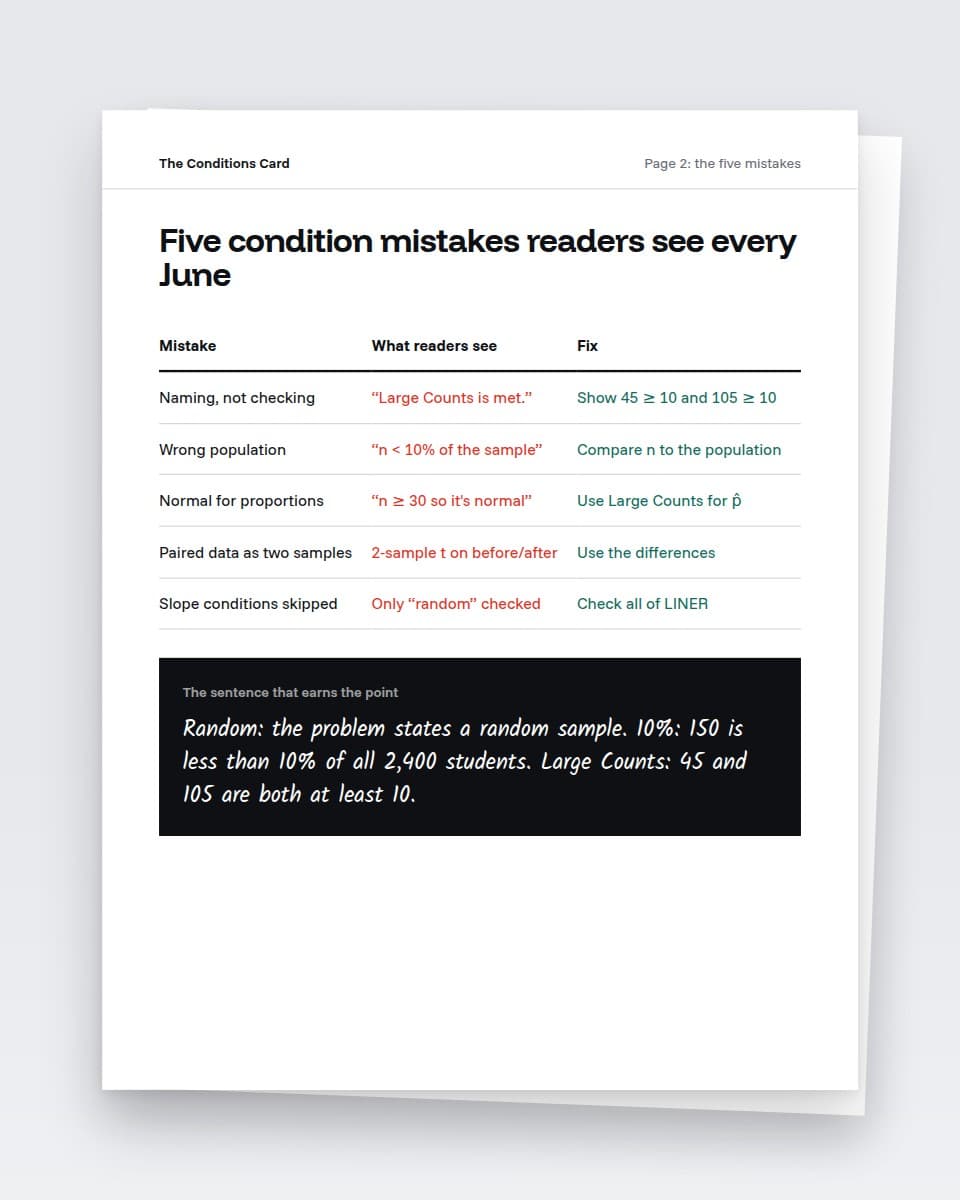
Two working AP Statistics teachers use each new book with their classes for a unit. Anything their students misread gets fixed before release.
Stuck on a question in one of the books? Ask the person who wrote it.